
A Voice in the Fire: Tolkien’s Paradox of Power
How the desire to master all things ultimately incites its own undoing.

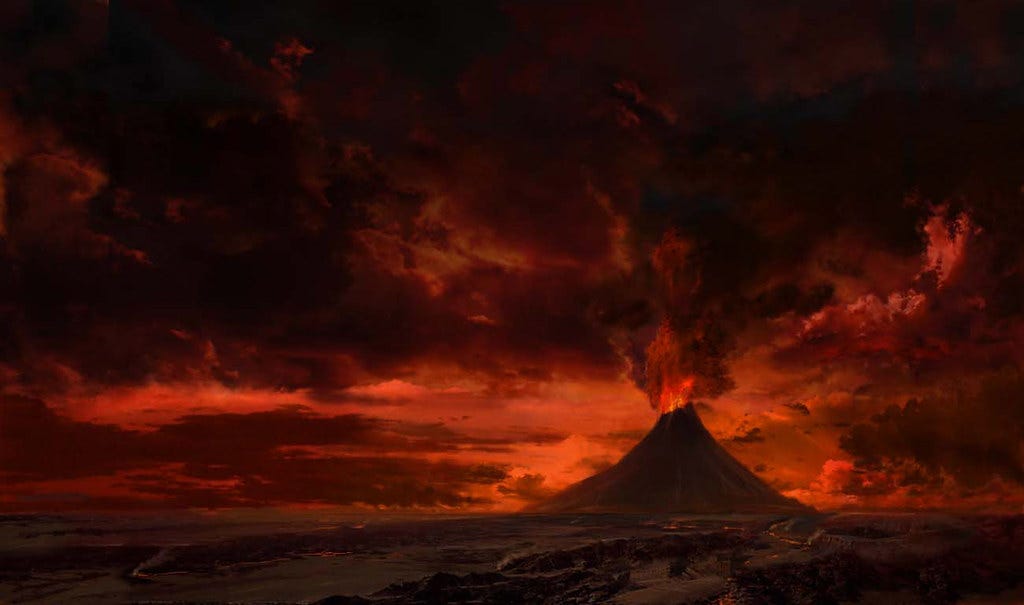
I am haunted by a passage from the latter half of the The Return of the King. It is a familiar setting. Frodo and Sam are on the slopes of Mount Doom—nearing the end of their arduous journey. Sam has been carrying Frodo, now too weak to walk on his own, when Frodo is overwhelmed by a sense that the Eye of Sauron has spotted them at last. As the friends crawl slowly on, they are ambushed by Gollum, who is desperate to stop them and reclaim the Ring at the final hour.
Then an unsettling change comes over Frodo. His weariness fades, he fights back, overcomes Gollum, and is transformed. Sam sees:
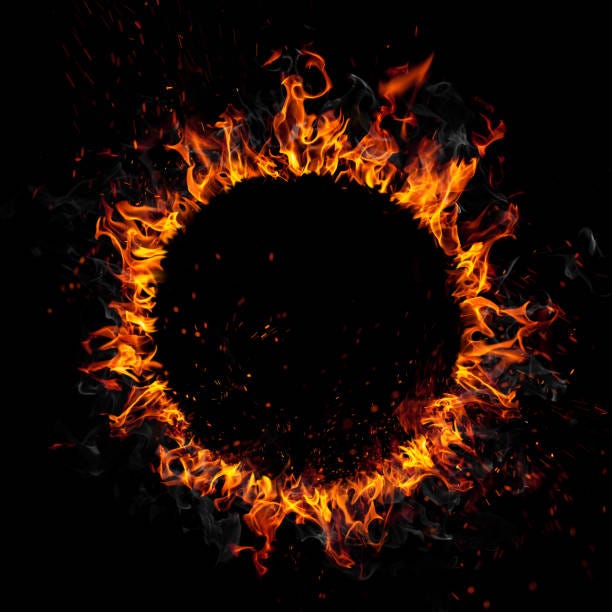
“A crouching shape, scarcely more than the shadow of a living thing, a creature now wholly ruined and defeated, yet filled with a hideous lust and rage; and before it stood stern, untouchable now by pity, a figure robed in white, but at its breast it held a wheel of fire. Out of the fire there spoke a commanding voice.
‘Begone, and trouble me no more! If you touch me ever again, you shall be cast yourself into the Fire of Doom.’”
Perhaps more than anywhere else in the trilogy, Tolkien creates a moment of immense thematic layering and complexity. The immediate question raised by this enigmatic passage is: exactly whose ‘commanding’ voice is this?
Ostensibly, it is the voice of Frodo, simply ordering Gollum to leave him alone. But this reading is complicated by how carefully the text tells us that, at least from Sam’s perspective, the voice is not coming from Frodo as such, but ‘out of the fire’—a ‘wheel of fire’ held at the breast of a white-robed figure. In this moment, Frodo appears almost as a vessel. As if someone—or something—is speaking through him.
It is hard to avoid a sense that the Ring itself—now so close to the fulfilment of its long desire to reunite with Sauron—has finally entered the conversation. It speaks with a wrathful voice of dominance and power, but also one contextualised by a long history. Having spent centuries bound to Gollum in its failed attempts to return to Sauron, the Ring has endured what must have felt—within Tolkien’s moral logic—like prolonged humiliation. Now, carried at last to the brink of its long-desired fulfilment, it will tolerate no further interference.
For the Ring has found a new bearer: one who has carried it across Middle Earth to bring it into the realm of fire where the culmination of ages of plotting and scheming at last lie within reach. Accosted once more by snivelling Gollum, the Ring has had enough. It lashes out, unleashing a curse upon the creature it has long despised. It speaks with the arrogance of absolute power, issuing a decree that it assumes will be the end of this unworthy distraction.
“‘If you touch me ever again, you shall be cast yourself into the Fire of Doom.’”
But these words are not merely a threat; they are a paradox and a prophecy. Words of power that usher in the Ring’s own destruction.
We all know what comes next. Frodo walks the Ring to the fire’s edge. There, at the last moment, he lacks the will to destroy it. Transformed, he places it on his finger. Sauron’s victory is at hand. It is only Gollum’s unexpected intervention that resolves what Tolkien himself later described as the inevitability of Frodo’s failure to complete the quest through sheer force of will (Letters, #246). Gollum again touches the Ring, and the prophetic curse comes to pass.
To understand the wider importance of what is happening here, let’s step back and consider Tolkien’s perspective on power more generally. Even when pursued with the best intentions, the desire to dominate, to impose one’s will over others and shape the world according to one’s own design, inevitably distorts the heart. Even Gandalf—an Ainu from the dawn of time—refuses to touch the Ring.
‘With that power I should have power too great and terrible. And over me the Ring would gain a power still greater and more deadly.’
The Ring itself incarnates this principle. It represents power abstracted from wisdom and responsibility. It promises clarity, order, and control, but it achieves these only by hollowing out those who wield it. It does not simply tempt its bearers. Through a combination of desire, paranoia, and ambition, power narrows the imagination until mastery over others feels like the only option.
And yet—and this is crucial—Tolkien does not tell a simple story in which power inevitably wins; nor one in which it is directly overthrown. Frodo and Sam are not immune to the Ring’s influence, but they resist it long enough for another more hidden story to unfold. That resistance, fragile and incomplete as it is, makes all the difference.
Their resistance is sustained by three interwoven qualities: friendship, endurance, and hope.
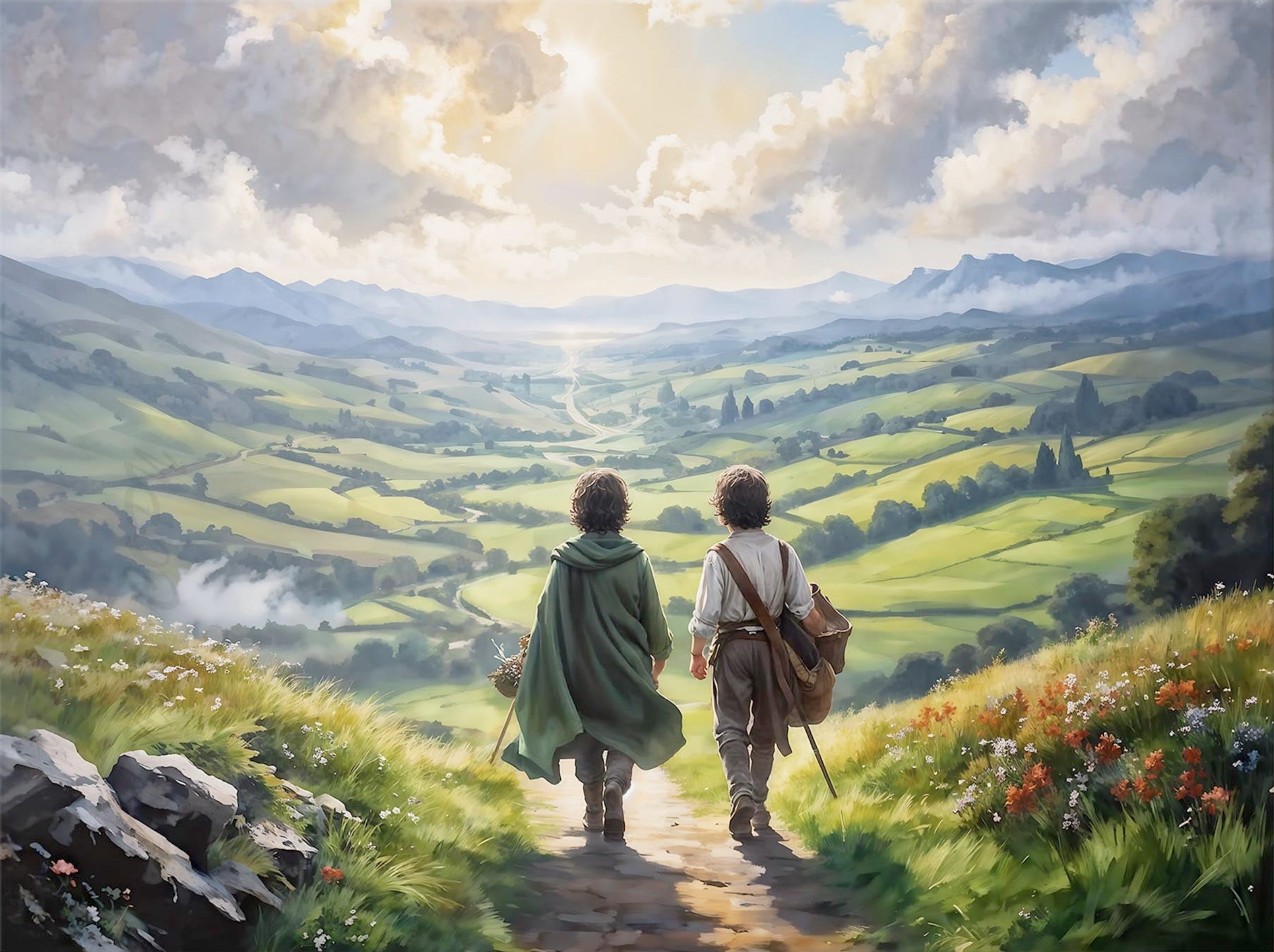
First, friendship. The journey to Mordor is not completed by a hero standing alone, but by two companions who care for one another in deeply ordinary ways. Sam cooks, carries, watches, and waits. Frodo trusts, listens, and accepts help. Their bond does not negate the Ring’s power, but it dilutes it. Love creates a space in which the dominating impulse cannot fully take root.
Second, endurance. Frodo and Sam do not defeat Sauron by confronting him directly. Spectacle and glory mean nothing to hobbits. Their struggle is slow, grinding, and often inglorious. Again and again, they choose not to seize power, not to strike first, not to respond to violence with wrath. This indirectness is not weakness; it is a kind of gentle intelligence, one that recognises the way overwhelming forces can be starved rather than challenged.
Finally, hope. Not hope as optimism or confidence in one’s own strength, but hope rooted in a deeper understanding of how power unfolds. Tolkien gives expression to this distinction in the dialogue Athrabeth Finrod ah Andreth, where, in the First Age, Finrod differentiates between Amdir, hope understood as expectation or favourable outcome, and Estel, a deeper form of trust that does not seek mastery over events, and therefore cannot be exhausted by failure. The hope that sustains Frodo and Sam is not confidence that they will succeed, but a refusal to let the logic of domination dictate the limits of possibility.
Tolkien repeatedly remarks how Sauron’s weakness is his shortsightedness, his impatience, and his tendency for overreach. His imagination has narrowed so completely that he can conceive of resistance only in terms of force. He mistakes patience for impotence and humility for irrelevance. In this sense, hope manifests as an awareness of the blind spots of domination—in the way power, obsessed with total control, sows the seeds of its own undoing.
This is exactly what we find on the slopes of Mount Doom. The Ring, in asserting its power over Gollum, commits a fatal error. It speaks as though its will were law, as though the future itself could unfold only according to its command. And in doing so, it binds itself to a future it cannot escape. Power, in this way, tightens its own noose.
We are told elsewhere in the story that no one is strong enough to destroy the Ring by force alone. Even the wise know this. Gandalf refuses it. Elrond does not trust himself with it. Frodo, at the very end, cannot relinquish it. Resistance, in Tolkien’s world, is not a matter of will or skill. It’s about holding on just long enough.
Holding on buys time. Time breeds impatience within power. Impatience fuels arrogance. Arrogance makes mistakes.
And so, the Ring’s decree comes true. Gollum does touch it again. He tears Frodo’s finger off his hand, takes the Ring and holds it with triumph. And in doing so—driven by lust, rage, and the very compulsion the Ring has cultivated—he unwittingly flings himself and the Ring into the Fire of Doom. The prophecy fulfils itself. The Ring is destroyed by the very words it spoke in anger.
This is the paradox at the heart of Tolkien’s vision: power unmakes itself through exertion. It overextends, flies off balance, and stumbles. It believes itself invincible, assuming the world will bend rather than break—and in doing so, creates the conditions for its own collapse.
The Ring itself contains this process within its shape. Circular, closed, self-referential: a system without escape. It recalls the myth of ouroboros, the serpent devouring its own tail: power feeding on itself until nothing remains.
What haunts me about this scene is not only its narrative brilliance, but its quiet moral insistence. Victory does not come from purity or strength or intelligence alone. It comes from refusing, again and again, to become what one opposes. From trusting that domination carries within it a fatal flaw. From believing that even in its shadow, on the very edge of the fire, there are forces—friendship, patience, hope—that power cannot fully comprehend or overcome.
Nice!
I’ve done a lot of critical study of “power”, and it’s always struck me that Tolkien’s story has an especially strong and unique perspective on this.